



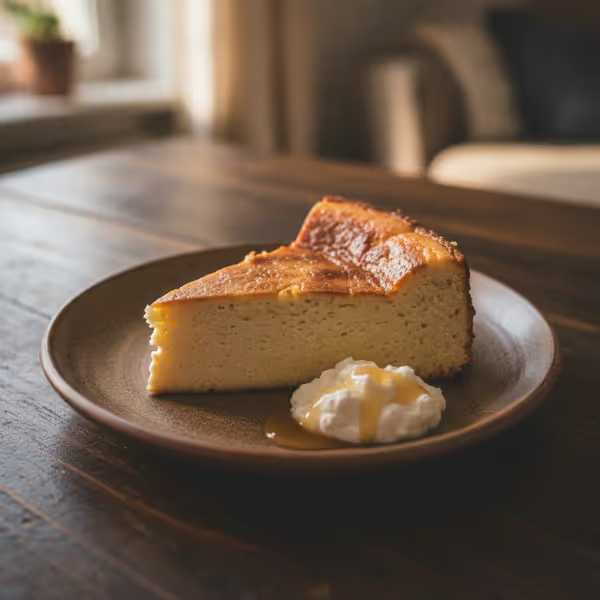
Fruity Quark Cheesecake

This fruity quark cheesecake is wonderfully moist, satisfyingly high in protein and surprisingly easy to make. Creamy low-fat quark, fresh berries and a gentle hint of vanilla make it a favourite for any occasion. It's sweetened with erythritol instead of table sugar, and if you fancy something different, a splash of baking cocoa turns it into a pretty marbled cake.
Ingredients
- 5 eggs
- 1 kg low-fat quark, or thick Greek yogurt / fromage blanc (drain well if using yogurt)
- 1 sachet vanilla custard powder, about 40 g; instant vanilla pudding mix works too
- 40 g protein powder, vanilla flavour recommended
- juice of 1 lemon
- 0.5 sachet baking powder, about 1 tsp
- 50-150 g erythritol sweetener, such as Xucker; adjust to taste, or use the same amount of caster sugar
- 2-3 tbsp baking cocoa, optional, for the marbled version
- 1 handful fruit, e.g. raspberries or redcurrants
The ingredient amounts above scale with your choice. The value per serving stays the same, while the total in the pot grows with the number of servings.
All nutrition values side by side
| Nutrient | per serving (estimate) | Total for 12 Servings |
|---|---|---|
| Calories | 145 kcal | 1,740 kcal |
| Carbohydrates | 9 g | 108 g |
| Protein | 18 g | 216 g |
| Fat | 3 g | 36 g |
| Fibre | 0.5 g | 6 g |
| of which sugar | 3 g | 36 g |
How this is calculated
Target amount = ingredient amount × target servings ÷ base servings. The result is then rounded for kitchen use: from 100 g or ml to the nearest 5, between 1 and 99 to the nearest 1, pieces and spoons to half units, amounts below one unit to quarters, thirds or halves. Teaspoons and tablespoons also go down to an eighth, kilograms and litres stay finer.
Total = value per serving × target servings. The value per serving is unchanged, because ingredient amount and serving count change by the same factor.
Sources
- Regulation (EU) No 1169/2011 (FIC), Art. 32 and 33: nutrition values per 100 g or 100 ml, additionally allowed per portion.
- European Commission, Guidance document for competent authorities for the control of compliance with EU food law, setting of tolerances for nutrient values declared on a label, December 2012.
Nutrition values are estimates from the recipe record, not laboratory results. Even for checked labels the EU sets tolerances: for fat, protein and carbohydrates 20 percent in the range of 10 to 40 g per 100 g, and 2 g per 100 g below that. Home cooking varies more, because variety, size and cooking loss of the ingredients differ. Kitchen rounding also shifts the total slightly against the plain rule of three. Anyone who has to keep amounts exact for medical reasons, for example during a nutrition therapy prescribed by a doctor, should discuss them with a doctor or a registered dietitian. Your serving count is calculated in your browser only, it is neither stored nor transmitted.
Instructions
- Preheat the oven to 170C (fan 150C). Line a 26 cm springform tin with baking paper.
- Whisk the eggs in a large bowl until light and frothy.
- Add the quark, custard powder, baking powder, protein powder, lemon juice and sweetener to taste. Mix well until you have a smooth batter.
- Pour half the batter into the prepared tin. Scatter the fruit evenly over the top, then cover with the remaining batter.
- For a marbled version: stir the baking cocoa into the second half of the batter, spoon it over the fruit, then swirl through with a fork before baking.
- Bake in the preheated oven for about 60 minutes. If the top browns too quickly, cover it loosely with foil and continue baking.
- Check with a skewer: if it comes out clean with no batter clinging to it, the cake is done.
- Remove from the oven, carefully run a knife around the edge and let the cake cool slowly.
Cooked it? Tell us how it turned out.
Did you like it? Rate this recipe
Nutrition facts per serving (estimate)
| Calories | 145 kcal |
|---|---|
| Carbohydrates | 9 g |
| Protein | 18 g |
| Fat | 3 g |
| Fibre | 0.5 g |
| of which sugar | 3 g |
Frequently asked questions
Is this quark cheesecake really gluten-free?
Yes, the recipe contains no flour. Just check that your custard powder and protein powder are also labelled gluten-free.
Can I swap the erythritol for regular sugar?
Yes, use the same amount of caster sugar. Keep in mind the cake will then be higher in sugar than the low-sugar version.
Which fruit works best?
Raspberries and redcurrants work especially well as they don't release too much moisture. Blueberries or pitted cherries are lovely too.
Why does my quark cheesecake sink after baking?
A little sinking is completely normal with quark cheesecakes. Let it cool slowly in the switched-off oven with the door slightly ajar, and only loosen the edge with a knife afterwards to minimise the drop.

Comments
No comments yet. Be the first to write one!
Thanks for your comment! We will review it and publish it shortly.