


Healthy Fats
What are healthy fats, and where do you find them? The idea that all fat makes you gain weight is simply wrong. Healthy fats are essential for your body. Here we answer the most common questions: Why does your body need fat? Why isn't all fat the same? And which foods are the best sources?

Fat makes you fat – that's true, right? Not really! Healthy fats are simply essential for your body. Here you'll learn what your body really needs fat for, why not all fat is the same, and which foods contain the valuable kinds.
Why does your body need fat?
Your body can't produce fat on its own, so you have to get it from food. Fat plays many essential roles along the way:
- A vital source of energy for the whole body
- Helps regulate and balance your hormones
- Supports healthy testosterone production, which matters for building muscle
- Builds fatty tissue that helps regulate body temperature
- Enables the absorption of the fat-soluble vitamins A, D, E and K
- Important fuel for your brain and its performance
As you can see, avoiding fat completely does your body more harm than good. What really matters is the type of fat you eat.
Why isn't all fat the same?
There are four groups of fatty acids, and they affect your body in very different ways:
- Saturated fatty acids
- Monounsaturated fatty acids
- Polyunsaturated fatty acids
- Trans fatty acids
Mono- and polyunsaturated fatty acids are considered high quality and are good for your body. A helpful rule of thumb is to get roughly a third from each of the first three groups. Flaxseed oil and walnut oil are polyunsaturated, while rapeseed (canola) oil and olive oil are monounsaturated.
Here's a practical example: a drizzle of olive oil over your carrots is what allows your body to make use of the vitamin A they contain (or its precursor, beta-carotene). Without fat, your body would simply pass this valuable nutrient straight through.
Saturated fatty acids and trans fats
Whipped cream, coconut fat, butter, meat and sausage all contain saturated fatty acids. Trans fatty acids are also saturated – these are the fats that change when food is fried or deep-fried. Think baked goods like croissants, deep-fried potato dishes and sweets.
Saturated and trans fatty acids are often labelled the "unhealthy" fats. Regularly eating large amounts may contribute to cardiovascular issues and weight gain over time.
Which foods contain healthy fats?
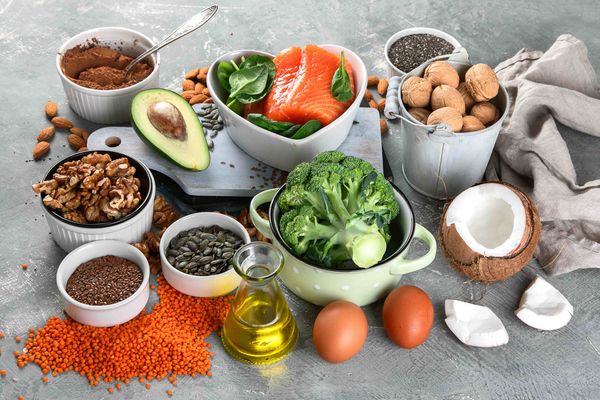
Healthy fats are easy to work into your everyday meals. These foods are especially good sources:
- Nuts and seeds: walnuts, sunflower seeds, pumpkin seeds, flaxseeds, chia seeds
- Fatty fruits: avocado, olives
- Cold-pressed oils: olive oil, rapeseed (canola) oil, flaxseed oil, walnut oil
- Oily fish: salmon, mackerel, eel
- Algae as a plant-based alternative
If you prefer to get your fats from oils, reach for cold-pressed varieties, as they're processed more gently and keep more of their nutrients.
Omega-3 fatty acids: especially valuable
One of the healthiest fatty acids is Omega-3, found mainly in oily fish (salmon, mackerel, eel) and algae. These sources supply DHA and EPA. DHA is present in your brain and plays a part in concentration, learning and mental performance.
How much fat per day is healthy?
Many people eat too much fat overall, with trans fats and saturated fatty acids making up most of it. General nutrition guidelines suggest a daily fat intake of around 60 to 80 grams, with roughly 30 percent of your daily energy coming from fats. The remaining 70 percent comes from proteins and carbohydrates, which are lower in calories.
If you'd like to know whether your fat intake is in a good range, working with a nutrition coach can help you build the right eating plan for you.
The takeaway: the right kind of fat matters
For a healthy, balanced diet, focus on unsaturated fatty acids. They support your wellbeing and vitality. Together with enough protein and the right carbohydrates, good fats form the foundation of a balanced diet.
If you'd like to learn more about this topic or fine-tune your nutrition, feel free to get in touch with our nutrition coaching team.
Frequently asked questions
What are healthy fats and why do they matter?
Healthy fats are mainly the mono- and polyunsaturated fatty acids found in olive oil, nuts, avocado and oily fish. They provide energy, support your hormones and help your body absorb the fat-soluble vitamins A, D, E and K.
Which foods are richest in healthy fats?
Especially good sources of healthy fats include walnuts, chia seeds, flaxseeds, avocado, olives and oily fish like salmon and mackerel. Cold-pressed oils such as olive, flaxseed and rapeseed oil also provide high-quality fatty acids.
How much fat per day is recommended?
General nutrition guidelines suggest a daily fat intake of around 60 to 80 grams, which is roughly 30 percent of your daily energy needs.
What is the difference between saturated and unsaturated fatty acids?
Unsaturated fatty acids (for example in olive oil, nuts and fish) are considered healthy and support wellbeing. Saturated fatty acids (in butter, sausage and cheese) and trans fatty acids (in fried foods and packaged baked goods) may contribute to cardiovascular issues when eaten in excess.
Note: This article is for general information only. It does not constitute medical advice and is no substitute for diagnosis or treatment by doctors or qualified nutrition professionals. If you have any health concerns, please see your doctor.